
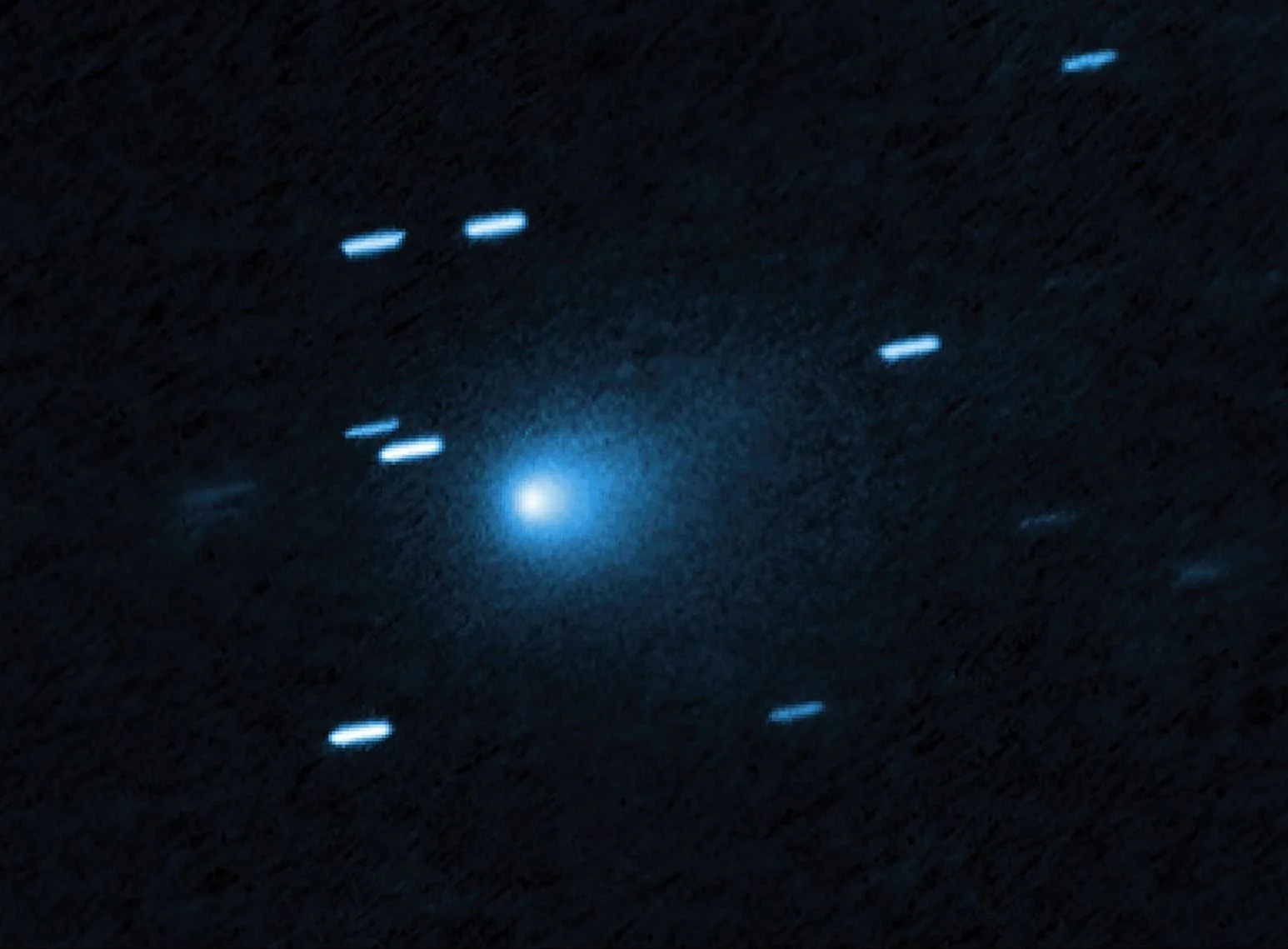
3i/Atlas – We don’t know what is out there..
By Jami Hossain
3I/ATLAS, the interstellar comet currently moving through the inner Solar System, has drawn global scientific attention. After passing the Sun, it will soon make its closest approach to Earth before continuing outward on its hyperbolic escape trajectory. Based on current assessments, 3I/ATLAS likely originated in the Milky Way’s thick disk, a region populated by ancient stars and long-evolved stellar debris. If this is correct, then with a transit velocity of roughly 60 km/s relative to the Sun, the comet could have been travelling for six billion years—longer than the Sun itself has existed.
In a galaxy as vast and active as ours, six billion years is an extraordinary span. One possibility is that the comet truly began its journey in the thick disk. Another is that it originated in a nearer stellar neighbourhood but entered the Solar System with a trajectory and velocity that mimic a more distant origin. Whatever the case, several profound questions arise.
The first concerns survival. For an object roughly the size of a major city, how did 3I/ATLAS remain intact over billions of years? To traverse the galaxy—through dense star fields, molecular clouds, planetary systems, supernova remnants, and countless gravitational perturbations—without fragmentation is statistically remarkable. Yet it arrived in a single coherent piece, erupting into a dramatic plume of outgassing as it passed near the Sun.
Alongside the scientific intrigue, a public controversy has emerged:
Is 3I/ATLAS a natural comet, or could it be something artificial?
Avi Loeb, Baird Professor of Science and Institute Director at Harvard University, has identified twelve anomalies in the behaviour of 3I/ATLAS that do not fit the standard comet model. Most scientists, however, maintain that it is a conventional interstellar comet. The question of artificiality is often dismissed out of habit—because no alien spacecraft has ever been confirmed, the default assumption is that none exist.
But this is not a logically rigorous position. The Milky Way contains 100–400 billion stars. The observable universe contains two trillion galaxies, giving an estimated 10²⁴ stars—more than all the grains of sand on Earth. The probability that our Sun is unique in hosting intelligent life is effectively zero. If other planetary systems exist—and if even one contains an advanced civilisation—then the possibility of artificial objects also exists. Rejecting the idea a priori is not scientific.
With 3I/ATLAS specifically, Loeb’s twelve anomalies invite careful examination, even if one ultimately accepts the natural model. The relevant publications are available for those who wish to evaluate the arguments directly here.
In a related CEPA post, we explored a rational scenario: If an extraterrestrial civilisation wished to explore another solar system discreetly, it would likely choose camouflage rather than spectacle. A brilliant metallic spacecraft would be an irrational choice. A comet-like object, by contrast, is ideal—common, expected, and capable of displaying irregularities without provoking alarm.
Comets are ubiquitous throughout the cosmos. When captured by a star’s gravity, they follow elliptical paths. Others, however, arrive on hyperbolic trajectories and simply pass through. Only three such interstellar visitors have ever been observed: 1I/ʻOumuamua, 2I/Borisov, and now 3I/ATLAS. If even one were artificial, camouflage would be the obvious strategy—not out of hostility, but out of prudence. Just as humans would avoid announcing their presence in an unknown star system, any other intelligent species would also act cautiously.
Meanwhile, Earth’s existence is no longer hidden. For a century, our radio and television broadcasts have expanded outward, reaching approximately 100 light-years. Our atmospheric biosignatures travel even farther. An advanced civilisation could already know far more about us than we imagine—including our technological capabilities. If so, their incentive to remain unseen only increases.
Perhaps 3I/ATLAS is simply a comet. Perhaps it is one of many such bodies passing silently through the outer Solar System. Or perhaps our galactic environment is more dynamic—and more populated—than we realise. The truth is that we do not know what is out there, and that uncertainty is precisely why 3I/ATLAS warrants deep scientific attention. Every interstellar object is a messenger from a region we cannot otherwise reach. Understanding these visitors is not speculation—it is necessary exploration.
As 3I/ATLAS departs the Solar System, it leaves behind a reminder:
The universe is vast, our knowledge limited, and the unknown always larger than the known.
Could an Interstellar Visitor Ever Be More Than It Appears?
The arrival of the interstellar object 3I/ATLAS has revived a question that lives quietly at the edge of astrophysics and strategic reasoning. Not the sensational query of whether it is artificial, but something more subtle and intellectually honest:
If an extraterrestrial intelligence were observing the Solar System, how would it choose to appear?
The popular expectation—that an advanced civilisation would announce itself openly, arrive in fancy star-trek-like space vehicles —may be the least realistic and least likely scenario. Any species capable of interstellar travel would also possess an understanding of risk, uncertainty, and the behavioural dynamics of encountering another intelligent society. Before they embark on any interstellar journey that may even take hundreds or millions of years, they design the journey with great caution. We can say caution is arguably a universal rational behaviour.
This leads to an intriguing possibility. If a civilisation wanted to examine a planetary system without attracting attention, the safest and most effective strategy would be a camouflage. And among all the natural forms it could emulate, a comet would be ideal.
Comets are expected.
Comets are variable.
Comets behave unpredictably without raising alarm.
They brighten and fade, shed material irregularly, accelerate due to outgassing, and regularly defy simple modelling. An object that appears mostly like a comet—but not perfectly—would still be classified as a comet, not a threat.
From a strategic standpoint, a comet-like disguise would be nearly perfect.
This becomes even clearer when the thought experiment is reversed. If humanity were ever to send an interstellar probe into another star system, would we broadcast our presence boldly? Or would we design something unobtrusive, passive, and difficult to distinguish from ordinary astrophysical debris? For durability, safety, and the avoidance of unintended escalation, the latter seems far more plausible. A darkened object. A dust-coated shell. A structure that mimicked a small asteroid or a comet nucleus. Such a probe would attract minimal notice.
Importantly, we do not claim that this is true for 3i Atlas. However, scientists are evaluating anomalies. While there is a great possibility that 3i Atlas is a natural object, one should not rule out some technological and artificial object. The NASA images to be releasd soon may shed more light on this aspect
What this reflection highlights instead is how interstellar visitors naturally broaden our conceptual space. They remind us that:
our observational sample of extrasolar material is extremely small,
our physical models are still evolving, and
our assumptions often rest on a narrow view of cosmic variability.
Every new interstellar object expands the frontier of what we consider possible.
Ultimately, this line of thought is not about aliens.
It is about intelligence, in the abstract.
It is about how any careful species—human or otherwise—would behave when confronting uncertainty.
And it is about intellectual humility: an awareness that the universe is vast, our knowledge incomplete, and our curiosity perhaps our most defining trait.
Whether 3I/ATLAS proves entirely typical or intriguingly unusual, it has already succeeded in one respect:
it encourages us to look deeper, think more broadly, and remain open to the unfamiliar horizons that interstellar visitors reveal.
3I / ATLAS: Rethinking Our Approach to Interstellar Evidence
Avi Loeb, the Baird Professor of Science and Institute director at Harvard University and the bestselling author of “Extraterrestrial” and "Interstellar" has become one of the most unconventional and visible scientific voices in recent years, particularly through his work on interstellar objects and his advocacy for bold scientific inquiry. His recent initiatives — especially 3I/Atlas is scientifically daring and aims to expand the way we detect, analyse, and interpret objects entering the Solar System from interstellar space.
While Loeb’s ideas often generate debate, they also raise important questions about how modern science approaches high-uncertainty, high-impact evidence — an issue where institutions like CEPA can play a unique role.
Interstellar Objects and the Case for New Observational Infrastructure
Following the discovery of ‘Oumuamua (2017) and Comet Borisov (2019), interest in interstellar visitors has grown dramatically. These objects provide rare opportunities to study material originating outside the Solar System, potentially carrying clues about:
planetary formation mechanisms,
astrophysical environments beyond our star,
the diversity of interstellar matter,
and even technological signals, if any existed.
Traditional astronomical surveys were not designed to track small, fast-moving interstellar bodies. Loeb argues that without new dedicated systems, humanity risks missing scientifically transformative data.
Asteroid Terrestrial-impact Last Alert System (ATLAS) — A Next-Generation All-Sky Surveillance System
Designed to provide rapid alerts for incoming objects with unusual trajectories, enabling telescopes to track them in real time.
Scientific Motivation: Beyond Conventional Models
Loeb’s work is frequently framed within speculative interpretations, but the stronger argument lies elsewhere:
our observational tools are incomplete.
Interstellar objects are:
faint,
dynamically fast,
often detected too late,
and require rapid coordinated follow-up.
Project 3I and ATLAS attempt to fill a clear scientific gap. Even without extraordinary claims, the scientific payoff is substantial:
improved understanding of interstellar composition,
constraints on galactic population distributions,
comparisons between Solar System and non-local materials,
and multidisciplinary applications (cosmochemistry, astrophysics, planetary science).
Why the Debate Matters?
Avi Loeb’s hypotheses — including the possibility of technological origins for certain anomalies (now 12 anomalies) — spark strong reactions. But the deeper issue is methodological:
Do we allow unconventional hypotheses to guide new data acquisition, as long as experiments remain rigorous?
How do we balance scientific conservatism with the possibility of rare, paradigm-shifting observations?
Is modern astronomy under-instrumented for low-probability, high-impact events?
These questions go beyond Loeb; they relate to the future of scientific infrastructure, including how independent groups like CEPA might contribute to decentralized, open-source observational strategies.
A Role for Independent Research Initiatives
Projects like 3I demonstrate that meaningful scientific progress does not always require large institutional frameworks. Independent institutes, small research groups, and open-access platforms can contribute to:
data interpretation,
modelling trajectories and dynamics,
testing alternative hypotheses,
developing analytics around early-warning systems,
and archiving open datasets for global research use.
CEPA’s intersection of physics, energy systems, and analytics is well-positioned to explore:
computational modelling of interstellar trajectories,
uncertainty quantification for rare-object detection,
physics-informed AI systems for anomaly identification,
statistical analysis of non-standard astrophysical signals.
Conclusion
Avi Loeb’s Project 3I and ATLAS initiative highlight a simple but profound idea:
we cannot answer the biggest scientific questions without first collecting the right data.
Regardless of where one stands on the interpretive spectrum, the push to build better observational tools for interstellar phenomena is timely, rational, and scientifically valuable.
For CEPA, the broader lesson is clear:
innovative science often begins where existing instruments and assumptions reach their limits.
Cosmological Tension: A Signal, not a Crisis
Modern cosmology has reached a stage where our measurements are precise enough that even small inconsistencies can become scientifically important. These mismatches, now grouped under the term cosmological tensions, are often described as cracks in the standard ΛCDM model. In reality, they tell us something deeper: the Universe is revealing information in ways that do not perfectly align with our current assumptions. At CEPA, we see these tensions not as failures of the model, but as signals directing us toward the next layer of physics.
Different cosmological observations probe different informational layers of the Universe. Local measurements—such as Cepheid variables and Type Ia supernovae—capture the late-time behaviour of an evolving, structured cosmos. Conversely, early-universe measurements, especially those derived from the cosmic microwave background, are built on a highly theoretical framework where the Universe behaves in a simpler, more uniform manner. When these observational regimes disagree, as they famously do in the case of the Hubble tension, it means the early- and late-universe information cannot be compressed into a single parameter consistently. This mismatch is not noise. It is structure.
Historically, similar discrepancies have been the starting point for major breakthroughs. The discovery of dark energy emerged from supernova observations that refused to fit expectations. The puzzle of the uniform CMB led to inflationary theory. Even the solar neutrino problem—an early and persistent tension—ultimately revealed neutrino oscillations and a deeper understanding of particle physics. Progress in cosmology has repeatedly come from the places where the Universe contradicted us.
In today’s era of high-precision cosmology, methodology has become inseparable from physics. Many modern tensions arise not purely from physical effects, but from the interplay between inference frameworks, calibration pipelines, nonlinear modelling, and machine learning tools used to extract cosmological parameters. As our instruments become more sensitive and our datasets more complex, the methods we use to process information begin to influence the physical interpretation itself. Cosmology is no longer only about what the Universe is doing—it is also about how we extract meaning from its signals.
From CEPA’s perspective, cosmological tension is a form of compressed information. It may indicate missing physical ingredients, overlooked relativistic effects, time-dependent parameters, or subtle mismatches between early- and late-universe modelling assumptions. It may also reveal how nonlinear structure growth influences measurements of expansion. But most importantly, tension shows us where our current models simplify the Universe too aggressively. It highlights the pressure points of ΛCDM—places where additional physics or improved analytics are most urgently needed.
Cosmological tension is not a crisis. It is the Universe refusing to be reduced prematurely. It is a directional signal, pointing toward deeper layers of understanding. At CEPA, we focus precisely on these regions of disagreement—where physics, analytics, and inference converge—and treat them as the most valuable opportunities for discovery.
CEPA Launch Announcement
Launch of CEPA
Introducing the Centre for Energy, Physics, and Analytics
Today marks the official launch of the Centre for Energy, Physics, and Analytics (CEPA) — an independent research initiative dedicated to advancing open scientific inquiry across theoretical physics, energy systems, analytics, and the interconnected scientific domains shaped by them.
CEPA was founded to create space for rigorous thinking, conceptual exploration, and interdisciplinary research unconstrained by traditional institutional boundaries. As science moves toward deeper convergence — where physics, energy, computation, biology, and data-driven analytics intersect — CEPA aims to operate at this frontier.
With this launch, we also introduce two core components of our research ecosystem:
CEPA-Despatch — our combined newsletter and blog for updates, short research reflections, notes, and commentary.
CEPA-xiv — our open-access research archive for working papers, essays, conceptual sketches, and independent, early-stage scientific ideas.
In the coming weeks, CEPA will begin sharing:
short research notes at the interface of physics, energy, analytics, and emerging sciences
highlights from new entries in CEPA-xiv
periodic updates on CEPA’s development as an initiative
reflections on the evolving landscape of interdisciplinary research
Thank you for being present at the beginning.
We look forward to building CEPA into a meaningful space for scientific thought and independent exploration.
— CEPA
The Physics–Computation Boundary Is Disappearing
Short reflections from CEPA on the emerging scientific convergence between physical laws, computational models, and energy systems.
Over the past decade, the separation between physical theory and computational intelligence has steadily eroded. What used to be distinct domains — mathematical physics, energy engineering, machine learning, biological modeling — are now interacting with unprecedented depth.
At CEPA, we interpret this shift as an early signal of a broader structural change in scientific methodology:
computation is becoming physical, and physical systems are becoming computational.
AI models are increasingly governed by physical constraints
Large-scale machine learning systems are no longer abstract mathematical objects.
Their capabilities are shaped by:
thermodynamic limits of hardware
energy efficiency of training
materials science of semiconductor fabrication
physical layout of compute clusters
In other words, the “intelligence frontier” is now an energy frontier.
Physical systems are now modeled as computational systems
Modern physics and engineering increasingly rely on:
differentiable simulations
physics-informed neural networks (PINNs)
generative models for materials discovery
data–driven climate and fluid models
These tools blur the line between equation and algorithm, expanding the way physical theories are explored and tested.
Energy, information, and complexity are converging
Across fields, three quantities keep reappearing:
energy (conservation, flows, dissipation)
information (entropy, inference, learning)
complexity (networks, emergence, adaptive systems)
This triad now shapes progress in:
battery technologies
renewable grid management
genetic and biological modeling
planetary-scale climate analytics
quantum and condensed-matter systems
It suggests that the next phase of scientific insight may emerge from hybrid models that treat energy + information as inseparable.
CEPA’s position in this emerging landscape
This convergence is exactly why CEPA was created.
Our work sits at the interface of:
theoretical physics
energy systems
computation, analytics, and data-driven science
CEPA will continue to explore this boundary — not as a collection of isolated topics, but as a single interconnected frontier.
- CEPA